



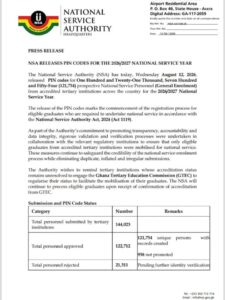
The National Service Authority (NSA) has released PIN codes for 121,754 prospective National Service Personnel from accredited tertiary institutions across the country for the 2026/2027 National Service Year.
The release, announced on Wednesday, August 12, 2026, marks the beginning of the online registration process for eligible graduates who are required to undertake national service under the National Service Authority Act, 2024 (Act 1119).
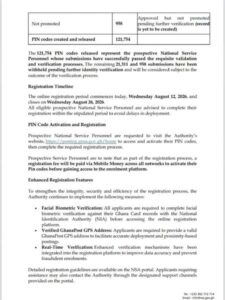
According to the NSA, a total of 144,023 personnel were submitted by tertiary institutions for mobilisation. Of this number, 122,712 were approved, comprising 121,754 unique persons whose records have been created, while 958 approved submissions are yet to have records created.

A further 21,311 submissions were rejected and are pending additional identity verification.
The Authority says rigorous validation and verification processes were conducted in collaboration with relevant regulatory institutions to ensure that only eligible graduates from accredited tertiary institutions were mobilised.
The online registration exercise commences today, August 12, and ends on August 26, 2026.
Prospective personnel are required to activate their PIN codes and complete the registration process through the NSA’s official registration portal. A registration fee will also be paid via Mobile Money across all networks to activate the PIN codes before applicants can access the enrolment platform.
The NSA has introduced enhanced registration measures, including facial biometric verification against Ghana Card records, provision of a valid GhanaPost GPS address, and real-time verification mechanisms aimed at preventing fraudulent and irregular enrolments.
The Authority has also urged tertiary institutions whose accreditation status remains unresolved to engage the Ghana Tertiary Education Commission (GTEC) to regularise their status to enable the mobilisation of their eligible graduates.
The NSA says the 21,311 rejected and 958 withheld submissions will be considered subject to the outcome of further identity verification.
By: Bernard Mensah






Discussion about this post