



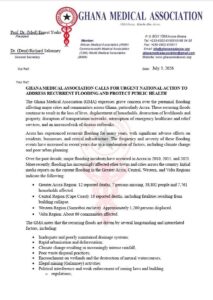
The Ghana Medical Association (GMA) has called for urgent national action to address recurring flooding across the country, warning that the situation poses a serious threat to public health and national development.
In a statement dated July 3, 2026, the Association expressed concern over the persistent flooding affecting major cities and communities, particularly Accra, saying the disasters continue to result in loss of lives, displacement of residents, destruction of property, disruption of transport networks, interruption of healthcare and relief services, and an increased risk of disease outbreaks.
The GMA noted that recent floods have affected several parts of the country, with initial reports indicating 12 deaths, seven missing persons, more than 38,800 people and 7,761 households affected in the Greater Accra Region. In the Central Region, 18 deaths have been reported, including fatalities linked to building collapses, while about 1,200 people have been displaced in the Western Region’s Samreboi enclave. Around 60 communities have also been affected in the Volta Region.

According to the Association, the recurring floods are driven by several longstanding factors, including poorly maintained drainage systems, rapid urbanisation, climate change, poor waste disposal practices, encroachment on wetlands, illegal mining activities, weak enforcement of planning regulations, and infrastructural deficiencies.
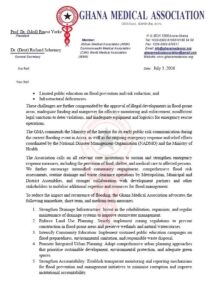
The GMA further observed that these challenges are worsened by illegal developments in flood-prone areas, inadequate funding and logistics for monitoring and emergency response, as well as insufficient public education on flood prevention.
While commending the Ministry of the Interior for its public risk communication and acknowledging the ongoing emergency response coordinated by NADMO and the Ministry of Health, the Association urged all relevant state institutions to strengthen relief efforts and improve collaboration in flood management.
To reduce the impact and recurrence of flooding, the GMA recommended rehabilitation and expansion of drainage infrastructure, strict enforcement of land use and zoning regulations, intensified public education on flood preparedness and sanitation, integrated urban planning, and stronger accountability measures to improve flood prevention and management initiatives.
By: Bernard Mensah |Planbfmonline.com



Discussion about this post