


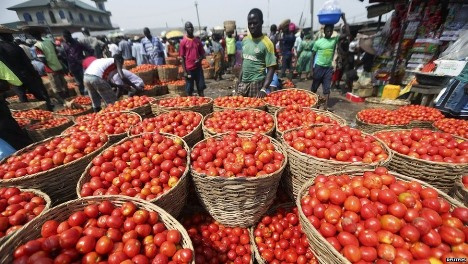
The Irrigation Company of Upper Region Limited (ICOUR) has earmarked 500 hectares of land under the Tono and Vea Irrigation Schemes for tomato production as part of efforts to reduce Ghana’s dependence on imported tomatoes.
The initiative, according to Dr Dominic Atogumsekiya Anarigide, Managing Director of ICOUR, is aimed at reviving the company’s past glory as a major producer of quality tomatoes while supporting government’s agenda to achieve food security and promote local production.
He disclosed in an interview with the Ghana News Agency on the sidelines of the inauguration of a nine-member Board of Directors of ICOUR in Bolgatanga on Tuesday.

Currently, the Government of Ghana spends between GH₵650 million to GH₵760 million annually on tomato imports alone, while spending over US$400 million on processed tomato paste and concentrate.
In 2025 and early 2026, trade faced severe disruptions due to Burkina Faso’s strategic shift toward prioritising domestic agro-processing, which restricted exports as well as suspected terrorists’ attack on Ghanaian tomato traders, leading to eight dead.
“ICOUR was known nationally and even internationally as a hub for producing tomatoes, not only tomatoes, but quality tomatoes for the region and the country. But for some time now, we have been doing only rice production, with some pepper and other crops,” Dr Anarigide said.
He explained that the decision to dedicate 500 hectares to tomato production followed a directive from Mr Eric Opoku, the Minister for Food and Agriculture, as government sought to reduce tomato imports and strengthen domestic production.
“We have a plan to revamp tomato production. This year, the Minister directed that we should dedicate about of 500 hectares to do tomato production, following what happened in Burkina Faso,” he said.
Dr Anarigide said the company had received organic fertiliser for the project, with about 6,000 pieces expected to support production at both the Tono and Vea irrigation schemes.
He said ICOUR was adopting a new production model that would address the lack of ready markets after harvest previously faced by farmers, adding that under the new arrangement, farmers would be linked with identified off takers before production begins to guarantee a market for their produce.
“We are now anchoring the farmers with an off taker. The buyers will come, sit with the farmers, sign an agreement, provide part of the inputs and they will be the ones to offtake,” he explained.
He said the arrangement would ensure that farmers knew their buyers before investing in production, while the off takers would provide guidance on production standards to ensure the tomatoes met market requirements.
“Unlike in the past, where we produced with the hope that a buyer would come, this time we get the buyer who interacts with the farmers, tells them what is expected, and the farmers also know what is expected from them,” he said.
He said ICOUR was also engaging stakeholders to identify suitable tomato varieties that would meet market demands, including learning from Burkina Faso’s tomato production model.
Mr Ibrahim Tia, North East Regional Minister, who inaugurated the board on behalf of the Minister for Food and Agriculture, urged ICOUR to revisit tomato production to reduce the country’s reliance on imports.
He charged the newly inaugurated board to provide the necessary leadership to make ICOUR’s irrigation facilities resilient and leave lasting legacies for future generations.
The nine-member ICOUR Board, chaired by Mr Akamugri Donatus Atanga, Upper East Regional Minister, comprised Mr Adam Jibril, an Accountant at ICOUR, who serves as Secretary, Dr Dominic Atogumsekiya Anarigide, Managing Director of ICOUR, Mr Gasper Dondaa, Upper East Regional Manager of GIDA, and Mr Eric Adu-Dankwa, Chief Executive Officer of GIDA.
The rest are Mr Gaddiel Idun Quansah, Deputy Director at the Ministry of Finance, Alhaji Zakari Fuseini, Upper East Regional Director of Agriculture, Mr Justice Ayine Atonbisko, Farmers’ Representative of the Vea Farmers Association, and Mr Robert Kwame Abokah, Farmers’ Representative of the Tono Farmers Association.
Mr Atanga pledged the commitment of the board to strengthen corporate governance, improve operational efficiency and position ICOUR as a centre of excellence in irrigation development.
GNA






Discussion about this post