


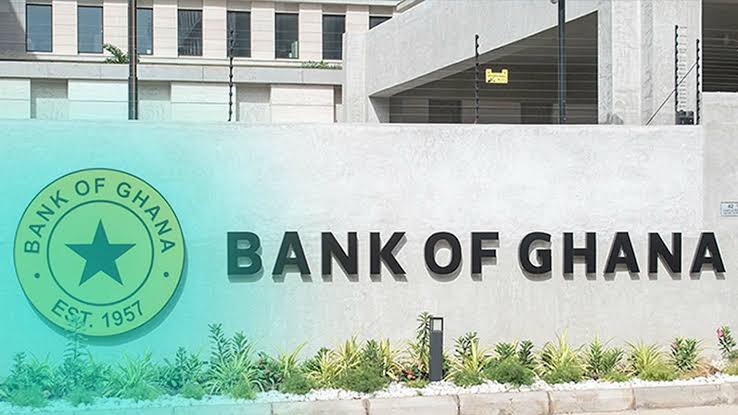
The Bank of Ghana (BoG) has cautioned the public to be vigilant against digital financial fraud and to take steps to protect their personal and financial information when using digital financial services.
The central bank said customers must safeguard confidential information such as Mobile Money PINs, ATM PINs, internet banking passwords, One-Time Passwords (OTPs) and verification codes.

According to the Bank of Ghana, no legitimate bank, mobile money operator, payment service provider or financial institution will request a customer’s PIN, password or OTP through phone calls, text messages, emails or social media.
The Bank therefore urged customers not to share confidential financial information with unknown persons, even when such individuals claim to represent a financial institution or telecommunications company.
It also advised the public to be cautious of unsolicited calls, text messages, emails, social media messages and online links that request personal or financial information.
The Bank of Ghana further warned the public to thoroughly verify investment opportunities before making payments or transfers, particularly schemes that promise unusually high returns with little or no risk.
It cautioned against “double-your-money” schemes, online Ponzi schemes and suspicious digital investment platforms, noting that such schemes could result in significant financial losses.
The central bank also encouraged customers to regularly monitor transaction alerts, bank statements and Mobile Money notifications to detect unauthorised transactions promptly.
It urged financial consumers to use strong passwords, update them regularly and activate available security features such as transaction alerts, biometric verification and two-factor authentication.
The Bank of Ghana further advised individuals not to disclose personal identification information, including Ghana Card details, account numbers and verification codes, to unauthorised persons.
Customers who suspect fraud, unauthorised transactions, SIM-swap incidents or account compromise have been urged to immediately report the matter to their financial institutions, mobile network operators or relevant service providers.
The Bank noted that under the Payment Systems and Services Act, 2019 (Act 987), financial institutions and electronic money issuers are required to maintain fraud-monitoring systems, cybersecurity controls and customer protection mechanisms.
It added that financial institutions and electronic money issuers are also required to provide clear complaint-resolution procedures and consumer protection measures for users of digital financial services.
The central bank encouraged customers to seek clarification in any language they understand whenever they do not fully understand a digital financial product, transaction or communication.
It also urged the public to avoid and report fraudulent links, fake websites and impersonation accounts on social media to the appropriate authorities.
The Bank of Ghana stressed that public awareness and financial literacy remain critical in the fight against digital financial fraud.
It called on parents, schools, financial institutions, telecommunications operators, regulators and the media to support continuous financial education and digital security awareness.
The central bank emphasised that financial inclusion without financial literacy could expose individuals to increased financial vulnerability.
It therefore urged the public to remain financially and security-conscious in all digital financial transactions, stressing that the fight against digital financial fraud requires collective responsibility through awareness, education, responsible financial behaviour and adherence to cybersecurity practices.
By: Bernard Mensah





Discussion about this post