


The Ghana Gold Board (GoldBod) has dismissed suggestions that Bank of Ghana Governor Dr Johnson Asiama’s decision to stop serving personally on its Board of Directors points to a disagreement between the central bank and GoldBod.
GoldBod Media Relations Officer Prince Kwame Minkah said Dr Asiama’s decision was simply a matter of representation and was permitted under the Ghana Gold Board Act, 2025 (Act 1140).

His comments follow reports that Dr Asiama had resigned from the GoldBod Board about five months ago and no longer attends its meetings. The Governor confirmed the development during the Bank of Ghana’s Monetary Policy Committee meeting on September 24, 2026.
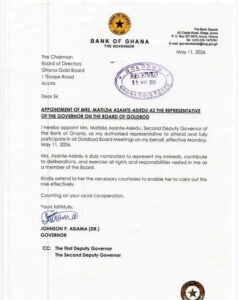
According to Mr Minkah, the Governor did not withdraw the Bank of Ghana from the GoldBod Board. Rather, he nominated the Second Deputy Governor of the Bank of Ghana, Mrs Matilda Asante-Asiedu, to represent him.
He said Dr Asiama formally communicated the decision to the GoldBod Board on May 11, 2026, citing his busy schedule.
Mr Minkah explained that Section 4(e) of Act 1140 specifically allows the Governor of the Bank of Ghana to serve on the GoldBod Board or nominate a representative who is not below the rank of director.
The provision states that the Board includes “the Governor of the Bank of Ghana or a representative of the Governor of the Bank of Ghana not below the rank of a Director nominated by the Governor of the Bank of Ghana.” The GoldBod’s official board information reflects the same arrangement.
Mr Minkah said the arrangement is not unique to the Bank of Ghana.
He noted that the Minister of Finance, Dr Cassiel Ato Forson, opted to nominate Deputy Finance Minister Thomas Nyarko Ampem to represent him on the GoldBod Board because of his schedule.
Similarly, the Minister for Lands and Natural Resources, Emmanuel Armah-Kofi Buah, initially served personally on the board before nominating the Ministry’s Chief Director, Mr Marcus Haligah, to represent him in January 2026.
GoldBod’s records show that Dr Asiama was initially appointed as a member of the board when it was inaugurated.
Mr Minkah therefore rejected suggestions that Dr Asiama’s departure from the board signals problems within GoldBod or a breakdown in relations between the two institutions.
“The fact that Dr Asiama no longer sits on the Board of the GoldBod does not mean that there is any ongoing rot at the GoldBod. Neither is there any fight between the BoG and the GoldBod,” he said.
He stressed that the Bank of Ghana remains represented on the GoldBod Board through its nominated representative.
Mr Minkah further described GoldBod as a key institution in Ghana’s foreign-exchange generation strategy and said it continues to work closely with the central bank.
GoldBod was established under Act 1140 in 2025 and is mandated to oversee and undertake the buying, selling, assaying and export of gold and other precious minerals. The Act also identifies generating foreign exchange and supporting gold reserve accumulation by the Bank of Ghana among GoldBod’s objectives.
The clarification comes amid renewed public discussion over the relationship between GoldBod and the Bank of Ghana, including concerns raised by the opposition New Patriotic Party about the central bank’s involvement in financing GoldBod’s gold-purchasing operations and the Domestic Gold Purchase Programme. Dr Asiama has said the law does not require him personally to sit on the GoldBod Board.
By: Bernard Mensah





Discussion about this post