


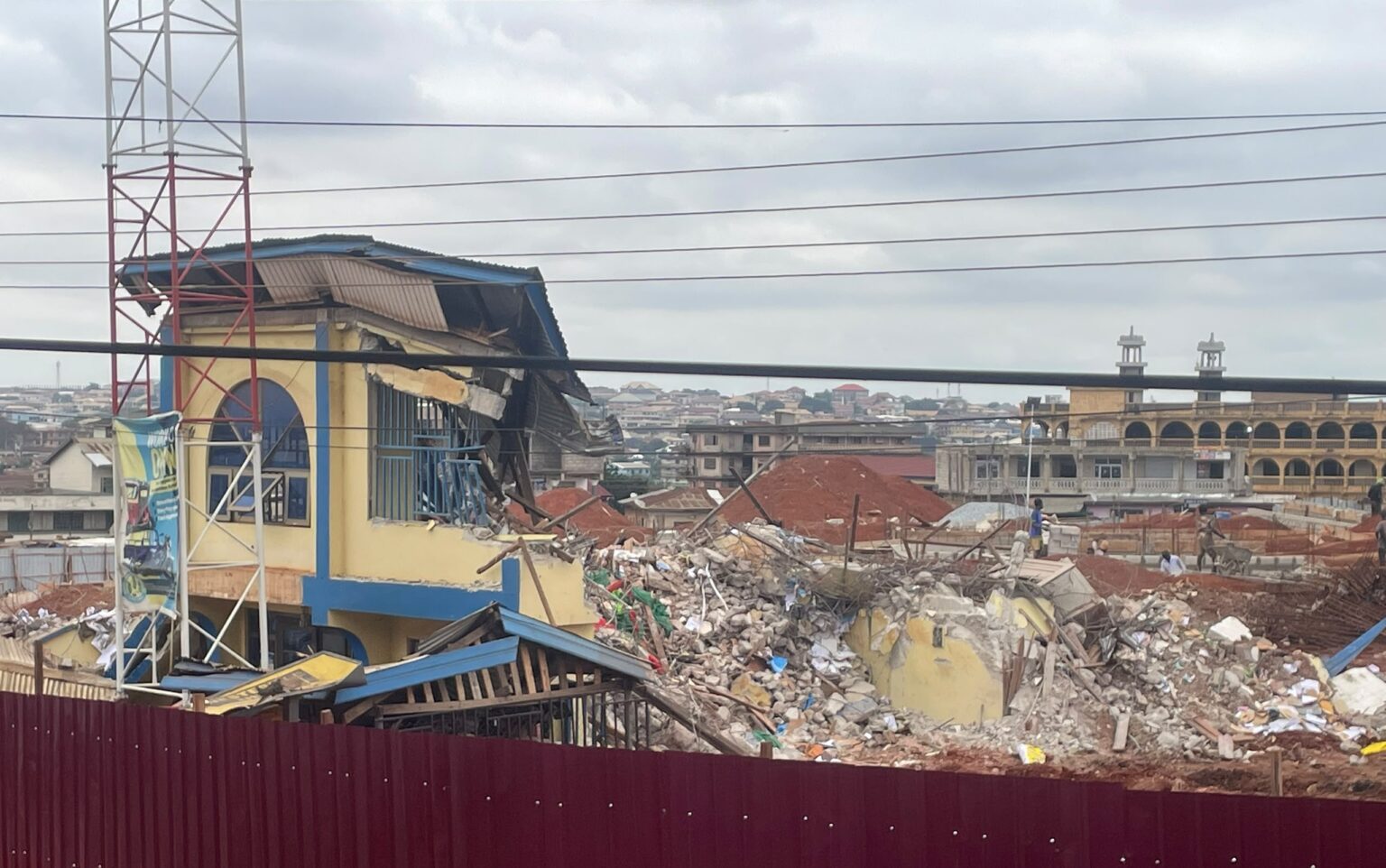
There is a growing standoff between the Asokore Mampong Municipal Assembly and Sekyedumase Community Bank PLC over the demolition of the bank’s Aboabo branch as part of plans to redevelop the market into a 24-hour economy facility.
The bank says its relocation had not been completed when its premises were demolished, raising concerns over a possible compensation claim and potential financial implications for the public purse.
The Assembly, however, maintains that it engaged the bank over the redevelopment and issued notices requiring it to vacate the site.

The dispute has triggered questions about the bank’s tenancy arrangement with the Assembly and whether the demolition could eventually result in legal and financial liability for the municipality.
Documents reviewed by this publication indicate that the Assembly began engaging the bank in 2025 over the planned redevelopment of the Aboabo Market and the need to relocate its branch.
The bank said discussions had included the possibility of incorporating its existing one-storey building into the design of the new market.
According to the bank, during a meeting on November 28, 2025, it was informed that consultants would assess whether the existing structure could be retained as part of the redevelopment.
The bank subsequently renewed the proposal, arguing that the branch serves as an important financial hub for traders, transport operators, small businesses, salaried workers and residents in the municipality.
It also said relocating a banking facility required technical and security assessments, regulatory approvals, board approval, installation of banking infrastructure and the secure transfer of customer records and other assets.
The bank therefore asked the Assembly for adequate time to complete the relocation process.
The Assembly rejected the proposal, saying the final architectural and engineering designs for the redevelopment did not allow the existing building to be retained or integrated into the project.
Five-day ultimatum
In a letter dated 15 June, the Assembly issued what it described as a “Final Warning to Vacate the Aboabo Market Redevelopment Site”, giving the bank five days to leave the premises.
The Assembly warned that failure to comply would compel it to take “all lawful measures necessary” to recover possession of the site and proceed with the redevelopment.
The bank subsequently protested the manner in which the matter was handled, particularly after contractors began placing laterite and other construction materials at the entrances to the premises.
It said the action disrupted banking operations and was followed by the disconnection of electricity to the building.
The bank also raised concerns about the safety of its property, saying the premises contained customer information, banking equipment, computers, furniture, records and other valuable assets.
In correspondence to the Assembly and institutions including the Ashanti Regional Coordinating Council, Bank of Ghana, ARB Apex Bank and the Ashanti Regional Police Command, the bank warned that demolition without a proper inventory and safeguards could have serious consequences.
“The Building contains a lot of information about its customers, modern banking equipment, data, furniture, computers and accessories and cash,” the bank stated.
It said it would assess the cost of relocating the branch and submit a claim to the Assembly for what it described as fair and adequate compensation.
Tenancy agreement
The dispute is further complicated by a tenancy agreement dating to 2003.
The agreement gives the Assembly the right to revoke the licence where national or public interest requires it, but provides that such revocation should be done “with notice”.
That provision could become significant if the bank challenges the demolition and seeks compensation for losses arising from the termination of its occupation and destruction of the premises.
Financial consultant Dr Solomon Aggrey said the dispute could ultimately centre on whether the contractual arrangement was properly terminated, whether adequate notice was given and whether the bank suffered losses for which it is entitled to compensation.
“This disagreement therefore goes beyond the physical destruction of the building and could potentially centre on whether the contractual arrangement was properly terminated, whether adequate notice was given and whether the bank suffered losses for which it is entitled to compensation,” he said in a media interview.
“Any such claim would have to be determined through the appropriate legal process. It would only become a judgment debt if a court ultimately rules in favour of the bank and orders the state or the relevant public authority to pay compensation.”
24-hour economy project
The demolition comes as the Assembly presses ahead with plans to transform the Aboabo Market into a flagship 24-hour economy market.
Hundreds of structures at the market were demolished in May to make way for the redevelopment, which the Assembly says will provide modern trading infrastructure and stimulate economic activity.
The proposed facility is expected to include sheds and lockable shops, parking facilities, police and fire service posts, a 24-hour clinic and pharmacy, a daycare centre and a Women’s Bank component.
The Aboabo project forms part of the government’s broader 24-Hour Economy and Accelerated Export Development Programme, known as 24H+, which seeks to extend productive economic activity beyond conventional working hours, improve market access, increase productivity and create employment.
The 2026 Budget describes the programme as a productivity-focused initiative aimed at accelerating industrialisation, boosting exports and creating more than 1.7 million decent jobs by 2028 across sectors including agriculture, manufacturing, logistics and services.
The programme gained statutory backing after President John Dramani Mahama assented to the 24-Hour Economy Authority Bill, 2025, in February 2026.
Source: Asaaseradio.com






Discussion about this post