


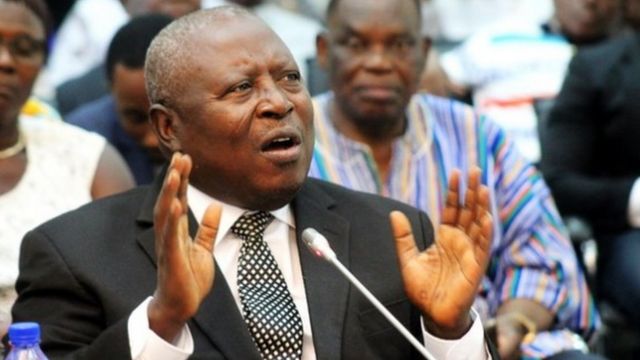
Former Attorney General and former Special Prosecutor Martin Amidu has argued that any change to Ghana’s presidential term-limit provisions should be decided through a national referendum rather than by a Supreme Court interpretation.
Amidu said Article 66(2) of the 1992 Constitution is an entrenched provision whose wording is clear and should not be expanded through judicial interpretation.
“Should the Supreme Court… proceed to amend the entrenched provision of Article 66(2) by reading into it the words ‘two consecutive terms’ it will be legalizing an automatic two consecutive terms for every President from the date of the decision,” he wrote.
Amidu maintained that the Constitution reserves changes to entrenched provisions for the sovereign electorate through the process outlined in Article 290.
“The question of the entrenched provision of Article 66(2) [ought] to be decided by the sovereign electorate at a referendum under Article 290 of the Constitution,” he stated.
His comments come as the Supreme Court considers legal actions seeking clarification on Article 66(2), which provides that a person shall not be elected to hold office as President for more than two terms.
One of the pending cases was filed by Ghanaian citizen Ganiwu Alhassan on July 9, 2026. The suit asks the Court to declare that the constitutional limit applies only to two consecutive presidential terms, arguing that a former president who returns to office after a break remains eligible to contest again.
Amidu argued that adopting such an interpretation through a court ruling, rather than a referendum, would alter the constitutional framework governing presidential tenure.






Discussion about this post