


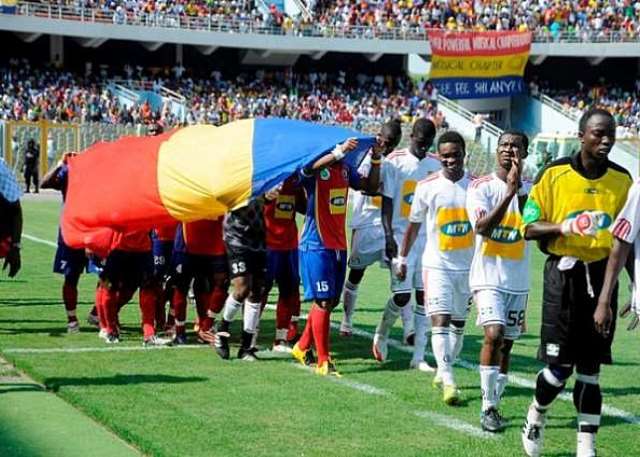
For generations, Ghanaian football has revolved around two institutions: Asante Kotoko and Accra Hearts of Oak. Their rivalry, the famed Super Clash, once defined the rhythm of the domestic league and projected Ghana’s football prestige onto the continental stage.


 Today, however, the narrative is shifting. Sparse stadiums, inconsistent performances, early continental exits and boardroom instability have combined to raise an uncomfortable question: are Ghana’s two biggest clubs gradually losing their grip on relevance?


A warning from within the game

The alarm has not come from critics alone but from respected voices in Ghana football. Former Nsoatreman FC General Manager Eric Alagidede issued one of the starkest warnings in recent years, arguing that Kotoko and Hearts could lose their relevance in the next 20 to 30 years if they fail to modernise their structures and management.
 His point was not merely emotional, it was structural. Football has evolved into a sophisticated industry driven by data analytics, commercial partnerships, youth development pipelines and global branding. Clubs that fail to adapt risk becoming historical exhibits rather than competitive institutions.


Other pundits, including former Black Stars defender Mohammed Gargo have repeatedly pointed to poor preparation for continental campaigns and lack of strategic planning as key reasons Ghanaian clubs struggle when they step beyond domestic competition.
From African royalty to continental spectators
There was a time when Kotoko and Hearts did not merely participate in Africa, they competed and conquered.
• Hearts of Oak lifted the CAF Champions League in 2000 and the CAF Confederation Cup in 2004.
• Kotoko, twice African champions ( 1970 & 1983), built a reputation as one of West Africa’s most formidable sides.
Today, they struggle to consistently reach the group stages of major CAF competitions. Meanwhile, African heavyweights such as Al Ahly, Zamalek, TP Mazembe, Mamelodi Sundowns have professionalised their systems, investing in modern training complexes, youth academies, international scouting networks and aggressive commercial marketing strategies.



The gap is widening.
Where these clubs operate as structured corporate entities with global ambitions, Kotoko and Hearts often appear entangled in local administrative turbulence, short-term decision-making and financial uncertainty.
The domestic shift: rise of the new order
Another layer of concern is the emergence of ambitious newer Ghanaian clubs. Teams like Medeama SC and Aduana FC have recently made deeper continental impressions than the traditional giants. The Ghana Premier League is no longer a predictable duopoly. This shift is healthy for competition, but troubling for institutions accustomed to dominance. When legacy clubs are overtaken by emerging sides with smaller fan bases but better structure, it signals systemic failure rather than temporary poor form.
Structural Cracks Behind the Decline
1. Administrative Instability
Frequent board changes, political influences and internal disputes disrupt continuity. Long-term projects rarely survive leadership transitions.
2. Financial Model Limitations
Both clubs remain heavily dependent on gate revenue and sporadic sponsorship. In an era where successful African clubs leverage merchandising, broadcasting deals and global partnerships, this model is outdated.
3. Youth Development Gaps
While Ghana is renowned for talent production, institutional academies linked directly to Kotoko and Hearts have not consistently produced first-team stars at the scale seen in North and Southern Africa.
4. Continental Preparation
African competitions demand logistics, depth, conditioning and tactical sophistication. Insufficient pre-season planning and inadequate investment in squad depth have repeatedly exposed Ghanaian representatives.
The Brand vs. The Product
Kotoko and Hearts remain powerful brands. Their fan bases stretch beyond Ghana’s borders. Their names still command emotional loyalty. But modern football rewards performance, governance and innovation not nostalgia.


History fills trophy cabinets; it does not win future matches.
The uncomfortable reality is this: if structural reforms are not implemented, the prophecy of decline may materialise. Ghana has already witnessed historic clubs such as Sekondi Hasaacas and BA United fade from top-tier prominence. Football history is unforgiving.
By: Bernard Mensah





Discussion about this post