


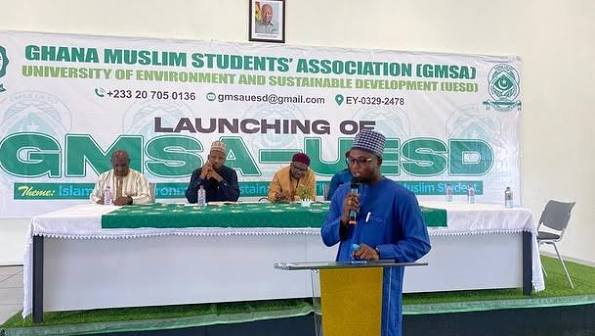
The Ghana Muslim Students’ Association (GMSA) is calling for the enforcement of existing policies protecting the religious rights of Muslim students in government-assisted mission schools.
The Association says reports of Muslim students being compelled to participate in Christian religious activities, as well as facing difficulties in observing basic Islamic practices in some schools, require urgent national attention.

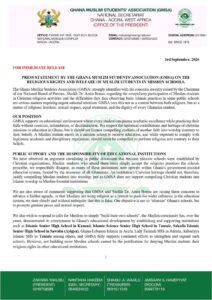
In a press statement issued on September 3, 2026, GMSA said the matter was not a contest between Christianity and Islam but one of religious freedom, mutual respect, equal treatment and the dignity of students.
The Association said while it respects the historical contribution of Christian missions to education in Ghana, that heritage should not be used to compel students of other faiths to participate in religious practices contrary to their beliefs.
GMSA argued that many mission schools now operate within Ghana’s government-assisted education system and are therefore supported by public resources.
It consequently rejected arguments that Muslim students who enrol in mission schools should simply accept the religious practices prescribed by those institutions.
The Association stressed that it equally would not support Christian students being compelled to participate in Islamic worship in Muslim-founded institutions.
GMSA also dismissed claims that the concerns raised by its leadership are part of an agenda to “Islamize” Ghana’s education system.
According to the Association, its objective is to promote peace, religious freedom and mutual respect within the country’s educational system.
Responding to calls for Muslims to build their own schools, GMSA said the Muslim community had already contributed significantly to education through institutions including Islamic Senior High School in Kumasi, Islamic Science Senior High School in Tamale, Sakafia Islamic Senior High School in Sawaba-Ayigya, Ghana-Lebanon Islamic Senior High School in Accra, Lady Fatimah Senior High School in Adenta and Anbariyya Islamic Senior High School in Tamale.
It maintained, however, that the absence of more Muslim schools could not be used as justification for denying Muslim students their religious rights in other institutions.
GMSA cites existing policy
The Association said the issue was not a new demand but one covered by existing policy.
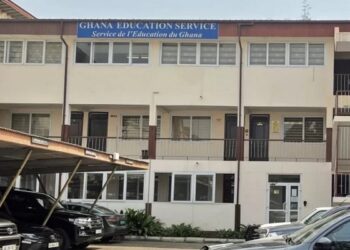
It cited the Ghana Education Service’s 2015 Directive on Religious Tolerance, which it says bars schools from compelling Muslim students to participate in Christian worship and protects their right to wear the hijab.
GMSA also referred to a 2024 Memorandum of Understanding involving key stakeholders and the Conference of Managers of Education Units (COMEU), which it says was endorsed by the GES in 2025.
The Association further cited Articles 17, 21 and 25 of the 1992 Constitution as providing additional protection for equality, religious freedom and the right to education.
It said other Muslim organisations, including the Coalition of Islamic Organisations, Ghana (CIHOG) and the Federation of Muslim Women’s Associations of Ghana (FOMWAG), had also called for the enforcement of the existing framework.
Concern over Ramadan
With Ramadan approaching, GMSA is particularly concerned about the ability of Muslim students to observe their religious obligations while in school.
It is therefore urging school authorities to give Muslim students reasonable opportunities to fast and pray without discrimination, punitive treatment or academic disadvantage.
The Association is calling on Parliament, particularly the Committee on Chieftaincy, Culture and Religious Affairs, the Office of the National Chief Imam, the Ministry of Education and the Ghana Education Service to urgently intervene.
It wants the authorities to ensure the implementation of the 2015 Directive on Religious Tolerance and the 2024 MoU with COMEU across all government-assisted mission schools.
GMSA has also appealed to the Muslim Caucus in Parliament, led by the MP for Bole-Bamboi, Alhaji Yusif Sulemana, as well as Muslim leaders, stakeholders and ultimately the Presidency, to support efforts towards a lasting solution.
The Association says it is prepared to engage the National Chief Imam’s office, Parliament, the Ministry of Education and both Muslim and Christian leaders through dialogue.
GMSA maintains that no student should have to surrender their faith in order to receive an education and says it will continue to pursue the matter until meaningful progress is made.
By: Bernard Mensah




Discussion about this post