


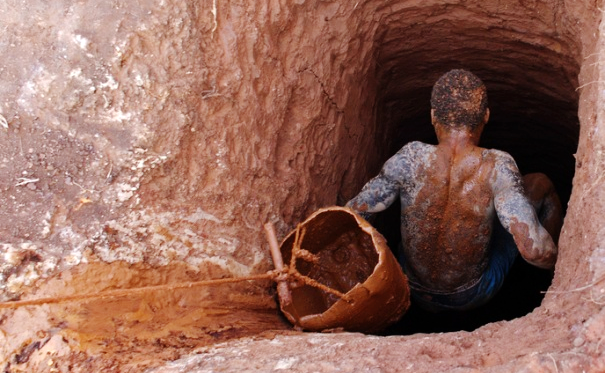
The National Fisheries Association of Ghana (NAFAG) has called on the government to fix the challenge with the menace of illegal mining locally known as ‘galamsey’ to help save the fishing industry.
Mr. Richster Nii Amarh Amarfio, the Vice Chairman of NAFAG, told the Ghana News Agency (GNA) in an interview that galamsey and other environmental issues have serious effects on the fisheries sector and must therefore be dealt with.
Mr. Amarfio “There is something fundamentally wrong with our fisheries sector, which cannot be attributed entirely to IUU. Fix the challenge with galamsey and its effect on the fisheries sector, as there is a relationship between the inland water bodies and the ocean.”

He added that it was important for the regulatory bodies to look at those environmental factors, such as galamsey contributing to the fish stock depletion, stressing that when a country loses its essential habitat, they would lose their fisheries.
“In the first place, the inland water bodies themselves are habitats for fish; they contribute to our fisheries demand, so when we destroy our inland water bodies, it puts unnecessary pressure on marine fisheries,” the NAFAG Vice Chairman stated.
He further explained that galamsey and other bad environmental practices destroy the coastline, which serves as spawning places for fish, emphasising that destroying mangroves, blackish water, and estuaries meant destroying hatcheries and spawning grounds.
Mr. Amarfio further noted that the flow from heavily polluted water bodies like Pra and Ankobra from upstream enters the sea around the mangroves and estuaries, making it urgent to address the issue of galamsey.
“It destroys the fisheries habitat because you are introducing toxic substances into your water, so you destroy the fish itself; they will move away from closer to shore into deeper waters,” he added.
He explained that the juveniles that are spawned by the fish often generally move close to shore to avoid predators; therefore, destroying the coastlines would make it difficult to do as they will die.
He said other environmental challenges that need attention to save the fisheries sector include the re-engineering of home and industrial waste as all drains in Ghana are connected into water bodies, which end up in the sea, leading to adding up of more waste to the water bodies.
He bemoaned the amount of plastic waste entering the ocean, lamenting that fishermen go to sea and come back catching more plastic waste than fish and have to hand-pick the fish from the garbage.
Mr. Amarfio said: “We need to begin to think about how to rebuild our fisheries; you can only think about rebuilding your fisheries when you deal with your environmental issues. It is about time we moved away from the fisherman centered approach of restoring the fish stock to management of the environment.”
He suggested that artificial reefs could also be created, just as strategically done recently by the USA, through the sinking into the ocean of a passenger vessel, to create a reef to serve as a spawning grounds for the fish to replenish their stock.
He further said spawning areas, such as mangrove and estuaries, could also be closed to fishing to protect juvenile fish to grow.





Discussion about this post