


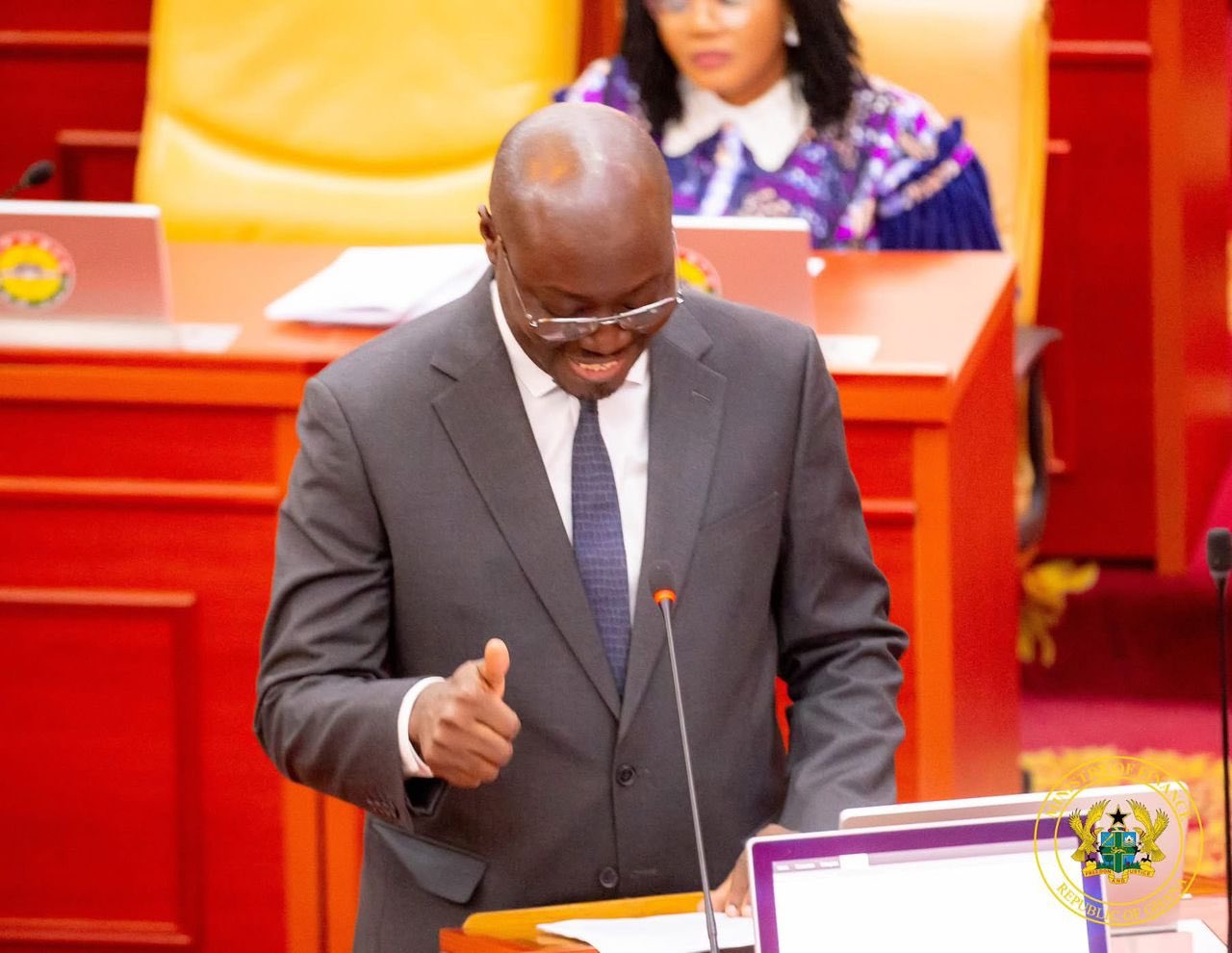
Finance Minister Dr Cassiel Ato Forson has dismissed claims that the government’s economic recovery narrative is propaganda, insisting that the economy is growing and the figures are supported by evidence.
His comments come as traders at the Kejetia Market in Kumasi complain of declining sales, high electricity bills and unreliable power supply, describing business conditions as increasingly difficult.
Dr Forson was speaking during an engagement at the Kwame Nkrumah University of Science and Technology (KNUST) on Monday, 9 November.


Advertisement
He said his responsibility as Finance Minister was to ensure that public funds were spent responsibly and that government did not commit to expenditure beyond its available resources.
“It is all propaganda in the sense that you have to earn money. And so as Minister of Finance, my responsibility is to put your money to good use,” he said.
“If somebody fails to work, I cannot spend your money. I cannot spend what is not there. I spend what is there.”
The Finance Minister explained that government revenue was derived largely from taxes, which must be allocated to meet obligations to individuals and institutions that had provided services.
He also pointed to growth in trade as evidence of an improving economy, arguing that claims to the contrary were not supported by data.
“If you look carefully at the growth numbers, and analyse it carefully, you will see that trade is growing. Trade is growing. And what is being said is not supported by evidence. There is no evidence for it,” he said.
“The economy is growing. The economy is doing well.”
Dr Forson further said the effects of the recovery were being felt by consumers, with market women reporting falling prices of goods and services.
“When you go and speak to market women, they will tell you that prices of goods and services are coming down. And people are now buying food,” he said.
Kejetia traders report declining sales
However, traders at the Kejetia Market have painted a difficult picture of their business conditions, citing low patronage, erratic electricity supply and high electricity bills.
They raised the concerns during an interaction with the Ranking Member of Parliament’s Energy Committee and MP for Afigya Kwabre North, Collins Adomako Mensah.
The engagement comes ahead of the presentation of the 2027 Budget by Dr Forson on Thursday.
One trader said many businesses had struggled to make ends meet over the past six months, despite having goods available for sale.
“For the past six months, I would say it is by grace. We are all crying,” she said.
“Now the goods are in. If the buyers sell the goods fast then we are safe. But that is not the case,” she added.
The trader also expressed dissatisfaction with the current economic conditions, saying she wanted the New Patriotic Party (NPP) to return to power.
“And so we want the NPP to come back to power because things are getting out of hand,” she said.
She further questioned the electricity charges imposed on traders, claiming they were paying substantial amounts for market lighting despite the absence of meters for the system.
“With the lighting system there is no meter here but we are paying huge bills,” she said.
Other traders raised concerns about unstable electricity supply, saying outages were affecting cold storage, lighting and the operation of electrical appliances used in their businesses.
“Business has been slow. We plan to seek audience from the Education Minister for his intervention,” says Emmanuel Asante, a 56-year-old tailor.
He explained that the Free SHS programme had previously created opportunities for local tailors through uniform contracts, while also helping families who could not afford to purchase school uniforms for their children.
“The Free SHS helped we the tailors because we were giving a lot of contracts and it helped the vulnerable who hitherto could not get money to purchase uniforms for their wards,” the tailor said.
However, the tailor alleged that schools had now taken over the supply of uniforms and were importing them from China, leaving local garment producers with fewer opportunities.
The trader also complained that parents were being directed to buy the imported uniforms, which they described as expensive.
“Now the schools have taken over our jobs and now import these uniforms from China and this has affected our business. And at the same time they have ordered parents to buy the imported uniforms and this is killing us,” the tailor said.
Traders want intervention
The traders appealed for measures to address the electricity challenges and ease the cost of doing business at the market.
Adomako Mensah assured them that their concerns would be raised at the appropriate levels, stressing that reliable electricity was essential to trading, employment and economic activity in the Ashanti Region.
The contrasting accounts come as attention turns to the 2027 Budget, which is expected to outline the government’s spending priorities and economic policy measures.
While Dr Forson maintains that economic growth and falling prices demonstrate a recovery, the Kejetia traders say weak sales and electricity-related challenges continue to affect their livelihoods.


Discussion about this post