


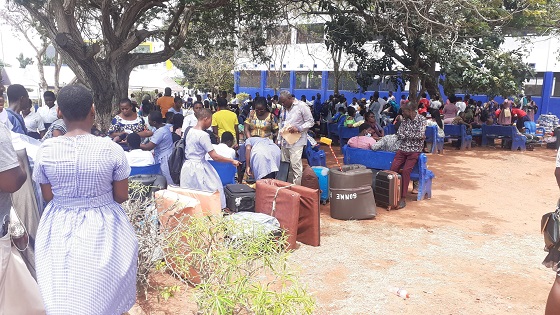
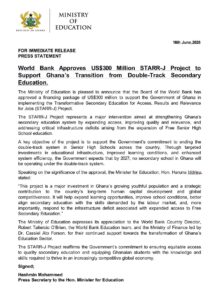
The World Bank has approved a US$300 million financing package to support Ghana’s efforts to improve secondary education and eliminate the double-track system in Senior High Schools by 2027.
The funding will be used to implement the Transformative Secondary Education for Access, Results and Relevance for Jobs (STARR-J) Project, a major initiative aimed at expanding access to quality secondary education, improving learning outcomes, and addressing infrastructure challenges resulting from the implementation of the Free Senior High School programme.
In a statement issued on June 16, 2026, the Ministry of Education described the project as a significant intervention designed to strengthen Ghana’s secondary education system through investments in school infrastructure, improved learning conditions, and enhanced efficiency in education delivery.

According to the Ministry, one of the key objectives of the STARR-J Project is to support the government’s commitment to ending the double-track system nationwide. The government expects that by 2027, all secondary schools in the country will operate under a single-track system.
Minister for Education, Haruna Iddrisu, said the project represents a major investment in Ghana’s youthful population and will contribute significantly to the country’s long-term human capital development and global competitiveness.
He noted that the initiative would expand learning opportunities, improve conditions in schools, and align secondary education more closely with the skills required by the labour market, while also addressing infrastructure deficits associated with expanded access to Free Secondary Education.
The Ministry expressed gratitude to the World Bank Country Director, Robert Taliercio O’Brien, the World Bank Education Team, and the Ministry of Finance, led by Dr. Cassiel Ato Forson, for their support in securing the funding.
The Ministry said the STARR-J Project underscores the government’s commitment to providing equitable access to quality secondary education and equipping students with the skills needed to succeed in a competitive global economy.
By: Bernard Mensah |Planbfmonline.com





Discussion about this post